

Navigating Polish E-Invoicing KSeF: Lessons for the Future of European Compliance
By Electronic Invoicing Global – September 2026 – 8 min read
Since KSeF (Krajowy System e-Faktur) went live for large taxpayers on February 1, 2026 and expanded to nearly all VAT-registered businesses on April 1, the European tax landscape has been under a stress test. Businesses across the continent look to Poland as a bellwether for upcoming e-invoicing and e-reporting requirements. For companies operating in Poland, or preparing for similar mandates across Europe, success now depends on moving beyond basic compliance and understanding the operational mechanics of real-time reporting.

Who This Effects
KSeF applies to all businesses registered for VAT in Poland. Not just Polish-headquartered companies, but also foreign entities with a Polish VAT number. The mandate is rolling out in three phases based on turnover:
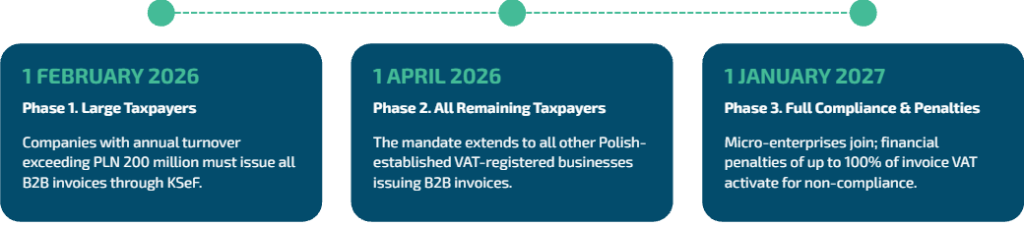
If you’re a multinational with a Polish subsidiary, a foreign entity with a Polish VAT registration, or a service provider with a Polish tax presence, you’re very likely already in scope. Businesses with no Polish VAT registration at all “those with no tax presence in Poland” fall outside the mandate, since they don’t issue Polish VAT invoices.
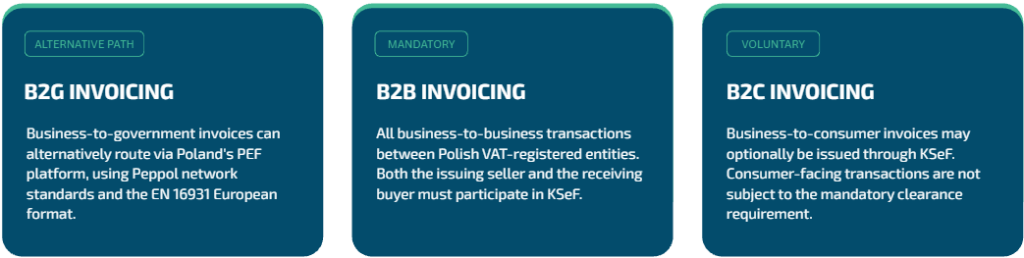
The Polish Compliance Landscape
A critical challenge for businesses in Poland has been distinguishing between e-invoicing and e-reporting obligations. Understanding the synergy between these two is essential to avoid non-compliance.
E-INVOICING
Focuses on the transactional flow between B2B and B2G entities. Requires structured, standardised XML formatting transmitted through the national platform. It is the core of the digital tax trail.
E-REPORTING
Handles transaction data that falls outside the standard e-invoicing workflow or requires supplementary detail. Capturing specific cross-border transactions or retail-to-consumer (B2C) elements that the standard invoice doesn’t fully address.
Organizations often fail by treating e-invoicing and e-reporting as silos. In the Polish mandate, these obligations are synchronized. Your ERP must be capable of distinguishing between a transaction that requires a structured invoice and one that necessitates an additional e-reporting data set.
Consider a cross-border supply of services. A non-established company might need to issue an e-invoice for the domestic portion of its supply while simultaneously generating an e-reporting file to satisfy local audit requirements for foreign transactions. Failing to synchronize these inputs leads to discrepancies in VAT returns.
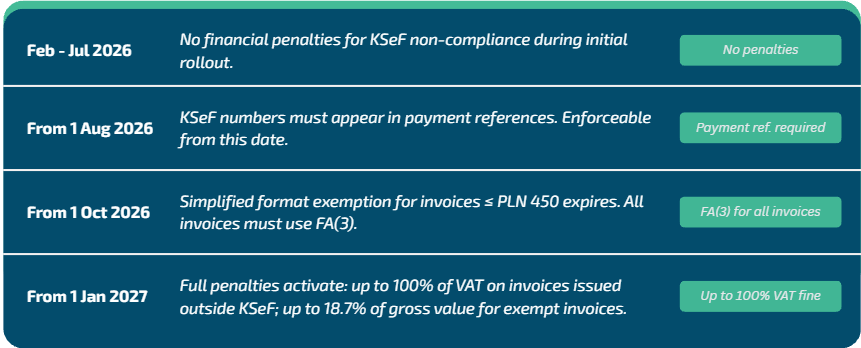
Penalties and Risks
2026 is largely a grace period but not without interim obligations.
For non-established companies, the Polish mandate has highlighted a significant shift in the role of the fiscal representative.
The fiscal representative is no longer just a tax agent. They are functionally responsible for the integrity of the data submitted. In the event of a penalty or audit discrepancy, the representative’s liability is significant. However, non-established entities often lack a direct technical bridge to the Polish tax authority’s systems. Relying on manual uploads or unverified third-party tools creates a “data gap.”
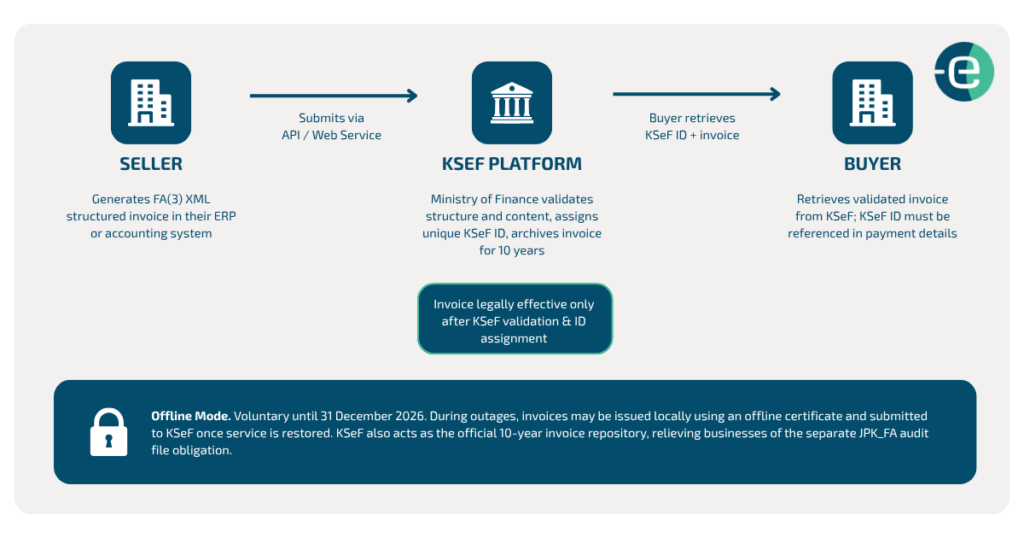
If an invoice is malformed or rejected by the platform, it may be treated as never having been issued. This means your customer can’t process payment until it’s corrected and resubmitted. A cash-flow problem regardless of whether a fine is attached.
Lessons from Poland: The Blueprint for Europe
The rollout of Poland’s mandate across its February and April 2026 phases provides a strategic roadmap for the rest of Europe. By analyzing this mandate, we can identify three core lessons.
LESSON ONE
LESSON TWO
LESSON THREE
Data mapping is non-negotiable
The biggest hurdle was not the technology itself, but the data mapping required to get there. Many companies retrofitting old accounting systems saw high rejection rates.
For other countries, start your data mapping at least 9 months before the mandate date. If your ERP data architecture does not natively support the required XML schema, invest in middleware solutions early.
The “fiscal rep” must be digital
Treating the fiscal representative as a “last-mile” solution (i.e., sending them a PDF to file) is a high-risk strategy.
Future-proof your organization by integrating your fiscal representative directly into your compliance workflow. Use platforms that allow representatives to access your data or validate your files in real time, rather than acting as a bottleneck in the reporting cycle.
Filing frequency and automation
KSeF does not replace periodic VAT returns. JPK_VAT filings continue on the same schedule, now expanded to include KSeF invoice numbers. What changes is that every B2B invoice must individually clear the KSeF portal at the moment of issuance.
Compliance can no longer be assembled at month-end, it happens per transaction. Any ERP that batched invoice data needed re-engineering to meet this requirement.
Staying Ahead
The Polish mandate is more than a local requirement; it is a preview of the standardized compliance environment Europe is moving toward. The risks of non-compliance, from operational and cash-flow disruption today to severe financial penalties once the grace period ends in 2027, are rising in tandem with the sophistication of tax authorities.
At Electronic Invoicing Global, we are committed to turning these regulatory complexities into manageable processes.
Are you prepared for the next wave of mandates? Visit Electronic Invoicing Global to explore our latest country pages and updates, or book a demo to learn more about how we can support your compliance journey.


Get in touch.
Do you have any questions regarding our knowledge base or would you like to know more about our services? We are ready to help you. Your success is our priority, and we look forward to working with you.